A REUTERS SPECIAL REPORT | By Tom Bergin, Michelle Conlin, Koh Gui Qing and Tom Wilson
WASHINGTON, D.C. (June 9, 2026) — It was January 2025, crypto fever was raging, and Donald J. Trump was preparing to return to the White House. So when Fatime Elrgdawy’s friend told her about an online message from the U.S. president-elect hyping the launch of his own crypto coin – “GET YOUR $TRUMP NOW” – she thought: “Oh my God, this is brilliant.”
If Trump was putting his name behind it, Elrgdawy recalls thinking, “it must be a legitimate investment.”
The 29-year-old software project engineer in Santa Barbara, California, put $2,000 of her savings into the $TRUMP meme coin – a purely speculative crypto token whose value is often driven by social media hype. All that remained, she thought, was to sit back and wait for the price to climb.
Instead, the price plummeted. At the end of May, her $TRUMP holding was worth less than $120. Meanwhile, the Trump family pocketed hundreds of millions of dollars from the token sales after putting little to none of their own money into the project.
The $TRUMP meme coin is one of four Trump family crypto projects that have turned into a financial jackpot for the Trumps and a very bad bet for buyers like Elrgdawy. While they vary in size and structure, each of these ventures has followed the same playbook. The Trumps risked little up front. Trump family members – notably, the president’s oldest sons, Eric Trump and Donald Trump Jr. – hyped the venture. The Trumps raked in money as investors piled in. And those buyers lost big when, for various reasons, the prices of their Trump-related crypto assets later tanked.
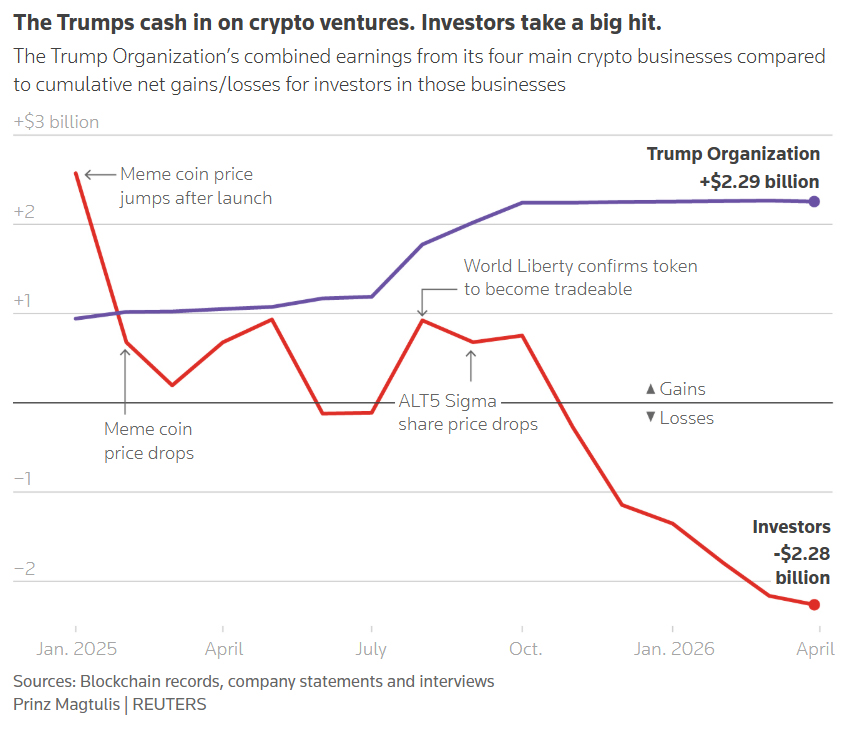
A Reuters examination shows that the Trump family has used this template to generate at least $2.3 billion in profit from investors since Trump retook the presidency. On the other side of that cash bonanza for America’s first family: the more than a million investors whose net losses totaled $2.3 billion at the end of April, according to a Reuters analysis. Those investors include retail buyers of crypto and crypto-linked equities, as well as those who invested indirectly through funds like ETFs with exposure to Trump crypto. The loss total includes paper losses on unsold investments.
The Reuters analysis of Trump crypto gains and investor losses was based on a review of blockchain records – essentially a database of crypto transactions – thousands of pages of corporate filings, online disclosures by the Trump companies, and public remarks by the Trumps and their projects’ executives, as well as interviews with crypto industry executives. The findings were reviewed by more than a dozen accounting and crypto experts, all of whom found Reuters’ estimates and its underlying analysis of the Trump businesses to be reasonable.
The four businesses covered in the analysis include World Liberty Financial, the Trumps’ flagship crypto venture. It has brought the family more than $1.4 billion from sales of its governance tokens on a persistent promise “to build and democratize a new financial system for the benefit of millions,” as it said in an early social media post. The tokens, which give holders a vote on some governance matters, have crashed in value.
The Trump brothers have also heralded two publicly listed firms, American Bitcoin and AI Financial Corp, known as ALT5 Sigma until April, as convenient ways to gain exposure to crypto tokens through their shares. The companies’ stock prices have collapsed. And there’s the $TRUMP token, its poor performance typical of meme coins, whose value reflects the popularity of internet trends or celebrities associated with them.
Reuters previously documented the hundreds of millions of dollars that crypto has brought to the Trump family. This report is the first to show that the Trumps have not only enriched themselves to an unprecedented extent for a sitting U.S. president and his family, but have done so through crypto deals that carried little to no downside risk for them while resulting in big losses for retail investors.
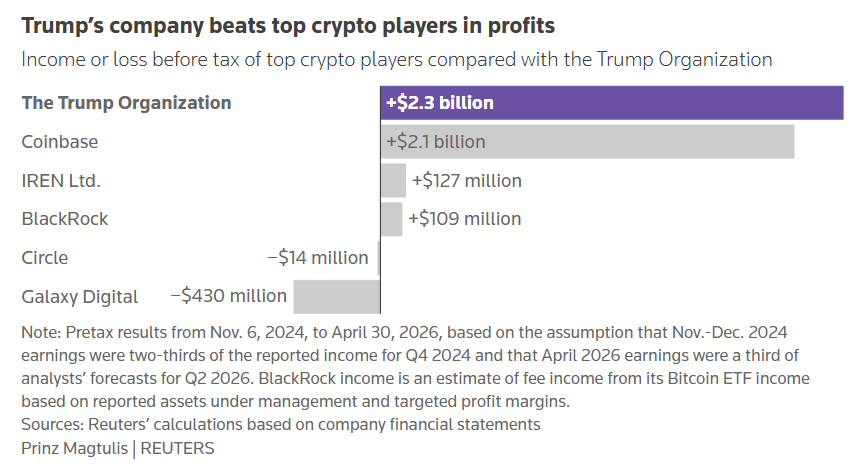
Since the November 2024 election, the president and his family have seized an enormous amount of the market for crypto token sales. Two of the four Trump ventures examined by Reuters have together sold more crypto tokens, by value, than any other crypto project but one, according to a Reuters analysis of industry data. And since the 2024 election, the Trumps have, as a family, generated more profit from crypto than any U.S.-listed company, according to company statements and industry data.
White House spokesperson Anna Kelly did not comment directly on Reuters’ findings and the experiences of investors who lost money on Trump crypto products. In an emailed statement, Kelly said: “All actions by President Trump and his administration are taken in the best interest of the American people.”
Eric Trump and Donald Trump Jr. did not respond to requests for comment.
REGRET, ANGER AND EMBARRASSMENT
All but three of the 27 individual investors interviewed for this article said they knew of Donald Trump’s history of bankruptcies, unpaid contractors and failed ventures. Still, most said they believed that his position at the apex of American political power and what they perceived as his business acumen ensured lucrative returns on their investments. Many acknowledged doing little or no due diligence. Some said they still hold on to the hope that Trump will make things right. Others expressed regret, anger and embarrassment.
They range from a Minnesota software engineer who said he lost $60,000 of his savings to a hotel manager in Vietnam who lost years’ worth of his income. They include the owner of an import-export business in Texas, a hospitality executive in Washington, D.C., and a retiree from New York.
Elrgdawy said it has become clear that “there’s no hope left” for her investment in the $TRUMP meme coin. She said she now thinks “it was just a pump and dump scheme” – when sellers of an asset talk up its price and then “dump” it for a profit before it crashes. Still, she said she considers herself lucky compared to other $TRUMP buyers who, in online chat groups, bemoan much steeper losses on a meme coin that has tumbled 97% from its January 2025 peak.
Elrgdawy was one of only seven retail buyers of Trump crypto who agreed to be identified for this story. The rest requested anonymity, the most common reasons being concerns about privacy and fears of doxxing or of retaliation, including from the president and his supporters.
Matt, a 45-year-old machinist in Indiana, said that last September, he was looking to reverse recent investment losses, so he put $40,000 – 30% of his crypto and stock portfolio at the time – in ALT5 Sigma shares. “When a stock has presidential backing in a way – at least from his sons – you would think it would go up,” he said.
Matt’s shares have dropped 79% in value since he bought them, for a loss of about $32,700. He keeps holding on, he said, because he thinks the stock is undervalued. “I call myself a loser, but I haven’t given up yet,” he said.
He does not blame the Trump family. He said he believes Democrats and anti-Trump investors are taking short positions – a bet that an asset’s price will fall – in the family’s crypto projects. “Here’s the dark side. I know all of these globalists have TDS and they are just going to short it,” he said, using the acronym for “Trump Derangement Syndrome,” the term Trump supporters use to describe what they see as an irrationally negative reaction to the president. He asked that his surname not be used to avoid politically charged blowback online and from people in his community.
A 45-year-old Texas businessman who put $5,000 into American Bitcoin said he bought the stock because “I just feel like Trump knows business.” He said he bought his shares at an average price of $4.19 last autumn. He sold all of them in December at about $3.50, for a total loss of about $800.
The Texan said he doesn’t hold the president responsible for the losses: “All the crypto is down right now, so you can’t just squarely blame it on Trump.” He added that he expects crypto to bounce back and that he recently started buying American Bitcoin again, at $1.13.
Only five of the investors reported making a profit. Four of them bought World Liberty tokens for pennies during early rounds of sales and then quickly unloaded what they could when 20% of their tokens became tradeable on crypto exchanges. They are still, hypothetically, in the money on the remaining 80% of their holdings, but won’t be able to cash out until World Liberty fully unlocks their tokens in 2030. The fifth investor made a profit day trading the meme coin.
John Paul Rollert, whose research focus at the University of Chicago Booth School of Business includes the history of capitalism and business leadership ethics, said retail investors should have asked themselves before committing whether the Trump family would make money even if the crypto ventures failed. If the answer was yes, “you’re now getting closer to what looks like a scam,” said Rollert, an adjunct associate professor of behavioral science.
World Liberty disclosed in fine print at the bottom of its website and elsewhere that the Trump family would receive the lion’s share of revenue from token sales. In marketing materials, it included disclaimers that its token was not an investment and that buyers should not expect to make a profit. The website for the $TRUMP meme coin contains similar warnings.
More broadly, U.S. financial regulators for years warned investors large and small that crypto was highly volatile and rife with scams. While such alerts have dissipated since Trump returned to the White House, financial authorities in many other countries have continued with that message.
‘THAT’S THEIR BUSINESS’
Renowned investor Wilbur Ross, who served as commerce secretary during Trump’s first term, said that, as with other U.S. politicians and their families, the Trumps are free to make money. As for individual investors, “if people are going to buy something that’s speculative, they ought to be aware there’s a risk,” said Ross, currently vice chairman of crypto company ReserveOne Inc. He added: “If they chose to continue on as a holder, hoping it would go up more, well, that’s their business.” Ross said he has not invested in any Trump crypto ventures.
Investors poured money into the Trump family’s ventures as the wider crypto market was riding high, buoyed by bets that a second Trump presidency would accelerate the emerging asset class’s entry into mainstream finance. On taking office, Trump began to put in place policies and initiatives seen as beneficial to the industry, from implementing federal rules for stablecoins to dialing back policing of the industry by the U.S. Justice Department and the Securities and Exchange Commission.
Eight government ethics experts interviewed by Reuters said that the Trump family’s enriching itself from an industry that the president’s administration regulates – and that the president himself has championed – represents a conflict of interest unlike anything seen in modern American history. They noted, though, that while this departure from established norms is unethical and unprecedented, it is legal, provided the family does not exchange access to the president or regulatory favors for financial gain.
In her statement, White House spokesperson Kelly said: “Neither the President nor his family has ever engaged – or will ever engage – in conflicts of interest. President Trump proudly made the United States the crypto capital of the world through executive actions.”
David Wachsman, spokesman for World Liberty Financial, said in an email response to Reuters’ request for comment: “World Liberty Financial is a private American financial technology company, not a political organization, and it is frankly un-American to suggest that a private enterprise in the United States cannot conduct business.”
The Trumps have reaped $2.3 billion from their crypto ventures by following a time-tested business model Donald Trump has applied to real estate – lending his family name to a project, rather than staking his own money. “The licensing deals are the best of all deals because there’s no risk,” Trump told Reuters in 2016. “The licensing deals are better because you don’t put up any capital.”
A CRYPTO CASH MACHINE
During the past year and a half, the president and his sons Eric and Donald Jr. have supercharged that approach, leveraging their vast media reach to turn the family’s crypto ventures into a global crypto cash machine.
The main component of that machine is World Liberty Financial. In October 2024, the venture, whose co-founders include the Trumps and a few longtime associates, began selling crypto tokens, with the brothers acting as primary pitchmen. They traveled the globe to amplify World Liberty’s stated plan to democratize finance, allowing anyone to bypass a traditional banking system they characterized as restrictive and unfair.
They aimed their pitch at potential crypto investors large and small, including accredited American investors – those who meet certain income and net worth requirements under U.S. regulations. For 1.5 U.S. cents per token, buyers would have limited rights to vote on key decisions about the platform, but they wouldn’t be entitled to any share of profits.
Just before token sales got underway, Donald Trump urged his millions of followers on the social media site X to buy, posting: “@WorldLibertyFi is planning to help make America the crypto capital of the world! The whitelist for eligible persons is officially open – this is your chance to be part of this historic moment.”
Many of these early investors figured they could profit handsomely once trading of the tokens began on crypto exchanges. But World Liberty prohibited them from selling more than 20% of their holdings, a move it said would ensure “broad ecosystem participation, and sustained growth as tokens gradually enter circulation.”
Then in April this year, World Liberty put forward a proposal, later approved by the largest holders of World Liberty tokens, that would prevent holders from fully unlocking their tokens until 2030, after Donald Trump is scheduled to leave office. World Liberty said the move would ensure long-term participation in the venture and a healthy market supply of tokens.
The lockup has left many investors frustrated and angry – not over losses, but because they have been unable to take ever-dwindling profits as the token price has fallen. One of them is a digital marketing professional in Europe who in January 2025 spent $45,000 to buy 3 million tokens. He sold 20% of his holding for a profit of $83,000 when trading on exchanges began last September. He could make $144,000 on his remaining 2.4 million tokens if he could sell them, but he can’t.
The locking of the tokens, he said, “is a complete sham” meant to extract as much money from investors as possible before Trump leaves office. He said that World Liberty has not responded to a notice of dispute and formal complaints he has filed with the company about the token lockup and that he is exploring legal options. “The community is being ghosted regarding this issue,” he said.
The European investor requested anonymity for fear of being harassed online, having all of his World Liberty holdings frozen or being denied entry to the United States. “I’m afraid of being targeted by the president of the United States,” he said, adding: “The MAGA crowd has shown, over and over, how relentless they are when it comes to defending their Dear Leader.”
Asked about the experience of World Liberty investors, Wachsman, the company spokesman, said in his email: “The World Liberty team has always been actively engaged with our community. We’re confident in the value of our ecosystem and have always taken a long-term view.” He noted that World Liberty founders, partners and other insiders are under a stricter locking regime of their personal token holdings than was imposed on the general public.
However, insiders like the Trumps have all along earned a cut from the hundreds of millions of dollars of tokens sold to investors.
Hong Kong-based crypto billionaire Justin Sun, one of the largest known individual investors in World Liberty tokens, in April sued the company in U.S. federal court, accusing it of extortion for allegedly pressuring him to invest in its stablecoin – a separate token – and then freezing his holdings when he declined to do so.
In early May, World Liberty, in turn, sued Sun for defamation in Florida state court for allegedly conducting a “public smear campaign” against the company. It alleged that he improperly transferred some of his World Liberty tokens to a crypto exchange and, separately, took short positions on the tokens as part of a coordinated campaign to push the market price down as public trading began.
Despite their frustrations, early World Liberty investors, who paid either 1.5 cents or 5 cents per token, are in a better position than many of those who have invested through crypto exchanges. When trading began on September 1, the token price surged from an initial 31 cents to 46 cents, then began its long, slow slide to around 6 cents at the end of April – an 87% decline.
For the Trumps, World Liberty has been nothing but upside. There is no evidence, based on a dozen interviews, as well as regulatory filings and public statements, that the Trumps invested any of their own money to create World Liberty. Even if they did, crypto industry consultants and academics said, the venture could have been established for less than $1 million, accounting for expenses such as code development and legal costs.
At the same time, the president licensed his name and image to the company as part of an arrangement that sends 75% of token sales to an entity named DT Marks DEFI LLC. That company is 70%-owned by the Donald J Trump Revocable Trust, which administers Donald Trump’s investments and is overseen by his children, and 30%-owned by other Trump family members.
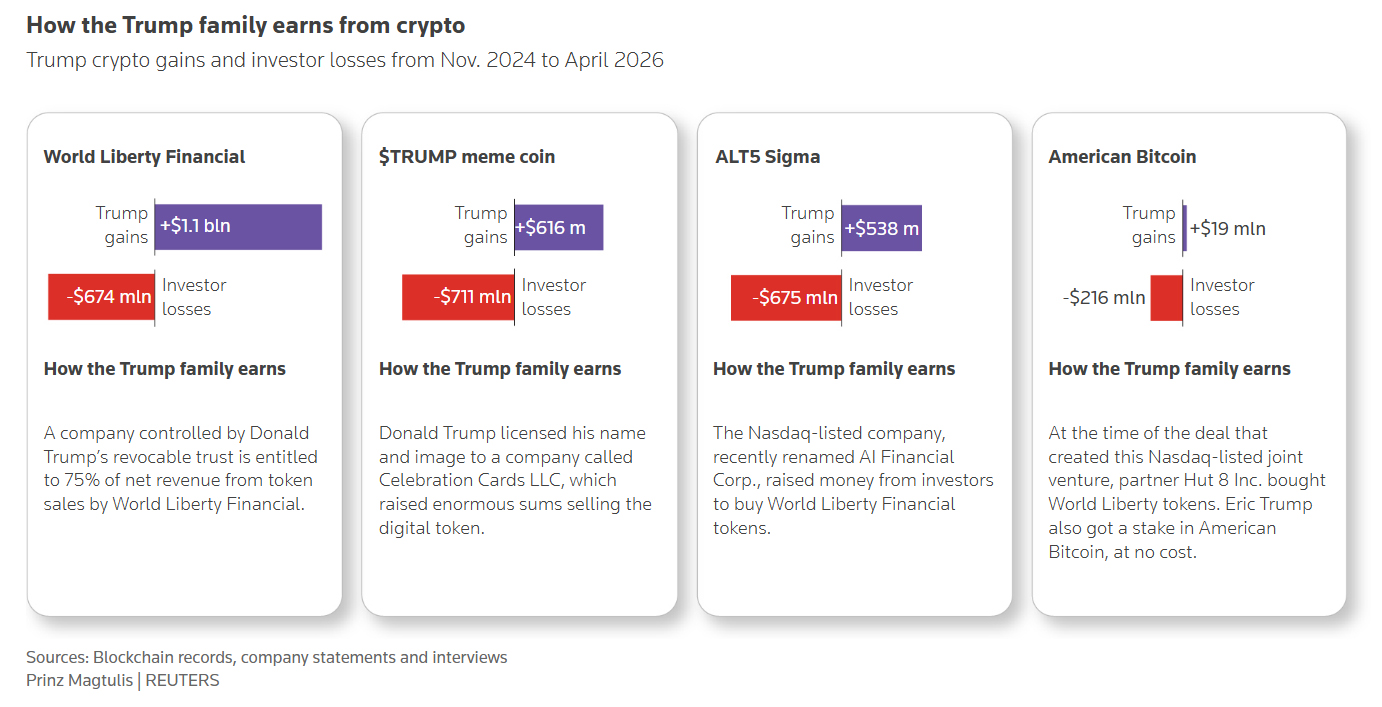
So far, World Liberty has funneled more than $1.6 billion to the Trump family – more than $1.4 billion from governance token sales and about $230 million from other ventures, according to Reuters’ calculations.
Meanwhile, total losses for investors – those who bought their tokens directly from World Liberty and those who bought via crypto exchanges – came to $674 million, according to Reuters estimates based on original sale prices and open-market prices as of April 30.
Wachsman, the World Liberty spokesman, said the governance tokens are “not an investment product.” He also said it was inaccurate for Reuters, in calculating gains and losses on World Liberty tokens, to “blur the lines between realized and unrealized losses.”
BULLISH NO MORE
One early World Liberty investor, a crypto executive, said that when he bought in January 2025, he was “bullish” on the investment because of the Trumps’ backing and the Trump administration’s vows to reshape the regulatory landscape in favor of the crypto industry.
He put more than $140,000 into World Liberty tokens at the presale price of 1.5 cents per token. He was able to sell 20% of his tokens in September for hundreds of thousands of dollars. His remaining tokens, though, are still locked. If he could sell them today, he would be due nearly half a million dollars.
His view of the Trump family and their crypto products has soured. “It’s simply a way to enrich the Trumps, not empower users to learn about and get exposure to crypto,” he said, requesting anonymity because he fears retribution by the company, the president and his supporters. For the same reason, he asked that Reuters not reveal the precise amounts of his World Liberty token purchases. He shared the address of his crypto wallet, which Reuters reviewed.
The tokens’ performance has not tempered the Trump brothers’ enthusiastic promotions of World Liberty as a revolutionary force in crypto finance. In February, they hosted an invitation-only World Liberty Forum at the president’s Mar-a-Lago Club in Florida. In his keynote address, World Liberty Chief Operating Officer Zak Folkman told the assembled crowd of Wall Street executives, marquee global investors and key U.S. financial market regulators: “There has never been a company like this, maybe in the history of finance.”
Despite the company’s promises to revolutionize finance, more than a year and a half after launching, the World Liberty website serves mostly as a conduit to crypto finance tools built by other companies.
Wachsman disputed that characterization, saying the company “has continued to succeed in its mission.” He pointed to the World Liberty-launched USD1 stablecoin, with a market cap of more than $4.5 billion, and the company’s pending application for a U.S. bank license, as well as the third-party tools and services available through the website. “We are proud of what we’ve accomplished already, but this is just the beginning of the journey for World Liberty and our community,” he said.
A MEME COIN LIKE ANY OTHER
On January 17, 2025, three days before his second inauguration, Donald Trump posted the message that Elrgdawy’s friend saw – exhorting the public to buy the $TRUMP meme coin, a pure money-making play separate from World Liberty. The following day, Eric Trump posted to his 6 million followers on X that it was the “hottest digital meme on earth.” The day after, Donald Jr. reposted Eric’s message as the coin reached its all-time high of $75.35.
The meme coin then plummeted by 80% as early investors took profits.
The meme coin’s performance has been typical for its kind. Academic studies of tens of thousands of launches have shown that these digital assets typically spike in price soon after being put on the market, often helped by promotion from athletes, celebrities or social media influencers, before collapsing. Academics describe such tokens in terms more often associated with gambling products than with investments, and say most buyers lose money on them.
For the Trumps, the venture entailed little if any financial risk. The $TRUMP website discloses that Donald Trump licensed his name and likeness for the coin. Reuters could not determine whether he spent any money on the project. If he did, getting it off the ground would have required less than $1 million, and possibly much less, to cover development, marketing and legal costs, according to academics who have studied cryptocurrencies and crypto industry consultants.
To date, the meme coin has generated about $616 million for the Trump family, while buyers lost more than $700 million, according to Reuters’ estimates.
Neither the meme coin’s website nor the Trump family business, known as the Trump Organization, responded to requests for comment.
TOKENS VIA THE STOCK MARKET
Last August, World Liberty Financial partnered with a small, loss-making Nasdaq-listed company called ALT5 Sigma and struck a deal under which ALT5 Sigma raised $750 million by selling new shares and used $717 million of that to buy World Liberty tokens.
The morning after the deal closed, Eric Trump and Donald Trump Jr. rang the opening bell at the Nasdaq market in New York. ALT5 Sigma was a way of “bringing crypto to the traditional marketplace,” Eric Trump said during an appearance that month on Fox Business. Donald Trump Jr., in an August 12 social media post, called it a “true breakthrough.”
In a September research note, investment firm Kingswood Capital told clients that for ALT5 Sigma, “getting into business with Trump & Co.” was a clear positive for the stock, citing the visibility and investor attention the partnership brought. In November, Kingswood said it was discontinuing coverage of the stock due to a “change of industry coverage focus.” Kingswood did not respond to requests for comment.
ALT5 Sigma’s share price soon began to slide, from a peak of above $9 in August 2025 to 75 cents in April 2026, a loss of about $675 million for investors. The plunge paralleled the decline in the World Liberty token price, as well as a broader fading of investor interest in so-called digital asset treasury companies like ALT5 Sigma.
The Trumps still came out ahead. Of the $717 million ALT5 Sigma spent on World Liberty tokens, more than $500 million went to the Trump family, based on their revenue sharing arrangement with World Liberty. Two finance academics interviewed by Reuters said they saw no evidence that the Trump brothers invested any of their own money in ALT5 Sigma, based on lists of top shareholders in regulatory filings and public statements. If they did own any of the shares directly, the combined value of their holdings would have been less than the $40 million threshold for disclosure.
One retiree from New York said he put $60,000 of his retirement savings into ALT5 Sigma at $7 a share after hearing on television about the Trump connection to the company. His investment was worth about $5,300 at the end of May, down more than 90%. He requested anonymity out of shame. “I was scammed and embarrassed,” he said.
In April, ALT5 Sigma said it had changed its name to AI Financial Corp. as part of a move toward “a broader financial platform.” In the email to Reuters, the company spokesperson said AI Financial continues to hold World Liberty tokens and is a “firm believer” in the crypto project’s stablecoin.
TAPPING THE BITCOIN CRAZE
A month after the ALT5 Sigma deal, the Trumps returned to the Nasdaq market with another crypto project – American Bitcoin.
Under this complex deal, energy infrastructure firm Hut 8 merged its loss-making bitcoin mining arm with American Data Centers, a small company backed by the Trump brothers. Hut 8 got an 80% stake in the merged company, renamed American Bitcoin, in exchange for its crypto mining machines. Hut 8 also offloaded onto the new company obligations to buy an additional $320 million worth of machines. The Trump brothers and American Data Centers shareholders got the remaining 20%.
American Bitcoin then obtained a backdoor Nasdaq listing through an all-stock merger with a small, loss-making company called Gryphon Digital Mining. The Trumps began promoting American Bitcoin shares, emphasizing that the company could amass bitcoin cheaply through mining and smart purchases. In a press release on the day of the company’s stock market debut, Donald Trump Jr. said: “With our Nasdaq listing, we are elevating this mission onto the global stage.”
At the time, bitcoin was hot, having more than quadrupled in price over the preceding two years to a record high of almost $126,000. Eric Trump, who serves as the company’s chief strategy officer, declared himself a “bitcoin maxi” – or maximalist – at a Wyoming crypto symposium and predicted the cryptocurrency’s “unstoppable” rise to $1 million.
In an appearance last September on a New York Post video podcast, he said: “Because of companies like American Bitcoin, for the first time, anybody who can buy an equity, anybody who can buy stock, anybody who has a 401(k) can invest a small amount in an asset that has had absolutely parabolic growth over the years.” In interviews and analyst presentations, he consistently said the company could mine bitcoin for half its market price.
In fact, after including depreciation and other costs, American Bitcoin lost money in 2025 and continued to do so as bitcoin crashed – by nearly 50% from its peak to about $60,000 in February. The company’s share price slumped from $11 at the September launch to around $4.20 by the end of November. It fell another 50% the next month when sales restrictions were lifted on Trump-connected early investors who had bought their shares at a discount. The stock closed at $1.15 at the end of April.
“American Bitcoin holds itself to rigorous standards,” said company spokesman Gautier Lemyze-Young. “From day one, we’ve implemented a clear and transparent governance framework with defined roles, responsibilities, and commercial terms.”
American Bitcoin’s share-price slide left the Trumps in the black. Eric Trump received a 9% stake in American Bitcoin, filings show. Experts who reviewed the company’s balance sheet said there was no evidence he put any money into the project. Eric’s shares, which he is restricted from selling, were still worth more than $70 million at the end of April. Donald Trump Jr.’s stake was not disclosed. In addition, Hut 8 bought World Liberty tokens soon after American Bitcoin was created, sending $19 million to the Trump family.
Outside investors have lost more than $200 million on their American Bitcoin shares.
